What Museum Holds Murals by Diego Rivera and Siqueiros in Catheredral of Mexico Art

David Alfaro Siqueiros, Dates in Mexican History or the Right for Culture, National Autonomous Academy of Mexico (UNAM), 1952-56, (United mexican states City, photograph: Fausto Puga)
Siqueiros and Mexican History
At the National Autonomous University of Mexico (UNAM) in Mexico City visitors enter the rectory (the primary administration building), beneath an imposing three-dimensional arm emerging from a landscape. Several hands, one with a pencil, charge towards a book, which lists critical dates in Mexico's history: 1520 (the Conquest by Spain); 1810 (Independence from Espana); 1857 (the Liberal Constitution which established individual rights); and 1910 (the starting time of the Revolution confronting the government of Porfirio Díaz). David Alfaro Siqueiros left the final date blank in Dates in Mexican History or the Right for Culture (1952-56), inspiring viewers to create Mexico'due south next groovy historic moment.
The Revolution
From 1910 to 1920 civil war ravaged the nation as citizens revolted against dictator Porfirio Díaz. At the heart of the Revolution was the conventionalities—itself revolutionary—that the land should be in the hands of laborers, the very people who worked it. This demand for agrestal reform signaled a new historic period in Mexican lodge: problems concerning the pop masses—universal public didactics and health care, expanded ceremonious liberties—were at the forefront of authorities policy.
Mexican Muralism
At the end of the Revolution the government deputed artists to create art that could educate the by and large illiterate masses almost Mexican history. Celebrating the Mexican people'due south potential to craft the nation'due south history was a central theme in Mexican muralism, a move led past Siqueiros, Diego Rivera, and José Clemente Orozco—known as Los tres grandes. Betwixt the 1920s and 1950s, they cultivated a style that defined Mexican identity post-obit the Revolution.
The muralists developed an iconography featuring singular, non-European heroes from the nation's illustrious by, present, and future—Aztec warriors battling the Spanish, apprehensive peasants fighting in the Revolution, common laborers of Mexico City, and the mixed-race people who will forge the next great epoch, like in Siqueiros' UNAM mural. Los tres grandes crafted epic murals on the walls of highly visible, public buildings using techniques like fresco, encaustic, mosaic, and sculpture-painting.
One of the earliest government commissions for a post-Revolution mural was for the National Preparatory Schoolhouse, a high school in Mexico Metropolis affiliated with UNAM. During the 1920s Los tres grandes and other artists completed works throughout the school'southward expansive exteriors and interiors.
Devastation of the old lodge
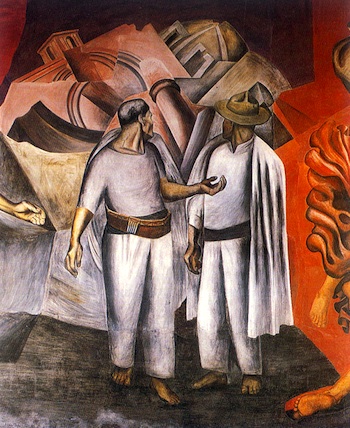
José Clemente Orozco, Destruction of the Old Order (item), 1926 (National Preparatory School, Mexico City)
Orozco painted about two dozen murals at the schoolhouse including Destruction of the Erstwhile Society, 1926. It depicts ii figures in peasant attire who watch nineteenth-century neoclassical structures fracture into a Cubist-like pile, signaling the demise of the by. Just equally Siqueiros' UNAM murals anticipate an unrealized historic event, the "new social club" unsaid in Orozco's piece of work is the world these men will come across once they plough to face the viewer. These anonymous men are unlikely heroes given their pocket-sized attire, all the same they represent a new age where the Revolution has liberated the masses from centuries of repression.
Murals for the Palace of Fine Arts
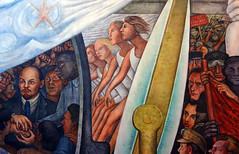
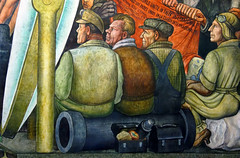
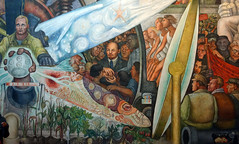
In 1934 the regime inaugurated the Palace of Fine Arts Mexico City, which soon became the nation's virtually important cultural institution. The Palace's Museum, Mexico's beginning fine art museum, opened the same year with works past 2 of Los tres grandes: Rivera'south Human, Controller of the Universe, 1934, a recreation of Man at the Crossroads (painted at Rockefeller Heart and destroyed the year earlier), and Orozco's Catharsis, 1934.

José Clemente Orozco, Catharsis (partial view), 1934 (Museum of the Palace of Fine Arts, Mexico City, photo: ryan griffis)
The title of Orozco's painting dates to 1942, when an art historian speculated that the burn at the acme of the composition symbolized catharsis, and thus "the just possibility of saving and purifying civilization" as it succumbed to the excesses of moral depravity. The laughing central figure jerks the viewer into an immoral world, where the malevolent aspects of modern life—senseless warfare, destructive applied science, and prostitution—run rampant.

David Alfaro Siqueiros, Torment and Apotheosis of Cuauhtémoc (detail), 1950-51 (Museum of the Palace of Fine Arts, photo: Jaontiveros)
In Torment and Apotheosis of Cuauhtémoc, 1950-51, another landscape at the Museum of the Palace of Fine Arts, Siqueiros explores the violent menstruation of the Conquest. In this mural Spanish soldiers torture the Mexican tribal leader for information on the location of the treasure they seek. The Mexican motherland, symbolized by the blood-stained female effigy, stretches her arms protectively over his still effigy. Siqueiros' penchant for sinewy limbs, showcased in the UNAM murals and exemplified here in the bodies of Cuauhtémoc and his praying companion, underscore the tension in this run into.
The Mexican Revolution was a watershed moment in the twentieth century considering it marked a true break from the past, ushering in a more egalitarian age. With its m scale, innovative iconography, and socially relevant message, Mexican muralism remains a notable compliment to the Revolution. The way the muralists reoriented history, recovered lost stories, and drafted new narratives continues to stir audiences and inspire artists, like the Chicano muralists that emerged in the U.Southward. Southwest. The fact that their in-situ masterpieces can yet be seen publicly in Mexico and beyond is a attestation to their relevance, popularity, and the ability of their didactic message.
Additional resources:
For instructors: related lesson plan on Art History Teaching Resources
Smarthistory images for teaching and learning:
More than Smarthistory images…
schlegelthellight.blogspot.com
Source: https://smarthistory.org/mexican-muralism-los-tres-grandes-david-alfaro-siqueiros-diego-rivera-and-jose-clemente-orozco/
0 Response to "What Museum Holds Murals by Diego Rivera and Siqueiros in Catheredral of Mexico Art"
إرسال تعليق